Solar Dryer Technology for Efficient Food and Agricultural Processing
Wiki Article
Introduction
Solar energy can be used for much more than electricity generation. Thermal solar technology can also provide useful heat for agricultural and food-processing applications. One important example is solar drying, where solar heat is used to remove moisture from suitable products such as fruits, vegetables, spices, herbs, grains, and other agricultural materials. Solar drying can provide an enclosed alternative to traditional open-sun drying and can be relevant to farmers, food processors, self-help groups, farmer producer organisations, and other businesses involved in value addition.
Rudra Solar Energy focuses on solar thermal equipment including solar dryers, solar cookers, solar ovens, and solar desalination systems. Its solar dryer range includes cabinet dryers and application-specific systems for different processing requirements. The company states that its solar dryers are available in configurations ranging from 5 kg per batch to 500 kg per batch, depending on the model.
What Is a Solar Dryer?
A solar dryer is an enclosed drying system that uses solar heat to raise the temperature of air and assist in removing moisture from a product. The basic principle is simple, but effective drying requires more than simply exposing food to sunlight.A properly designed dryer considers heat transfer, airflow, product loading, surface area, initial moisture, final moisture requirements, ambient conditions, and the characteristics of the material being dried.
Solar Drying Compared With Open Sun Drying
Open-sun drying places food or agricultural products directly in the outdoor environment. This approach is simple but exposes the material to dust, insects, birds, changing weather, and sudden rainfall.An enclosed solar dryer creates a more controlled drying environment. Rudra Solar Energy describes its cabinet solar dryer as an enclosed, tray-based system intended to reduce direct exposure to dust, insects, birds, and sudden rain compared with completely open-sun drying.
How Solar Drying Works
Drying involves moisture movement from the product into surrounding air. Solar heat raises the temperature of the drying air, while airflow helps move moisture away from the product.This relationship means that drying performance cannot be judged only by temperature. Product thickness, loading depth, humidity, airflow, solar radiation, and the desired final moisture condition can all affect the process.
Important Factors in Drying
A practical solar drying process may consider:- Type of product being dried
- Initial moisture content
- Desired final moisture condition
- Size and thickness of the prepared material
- Amount loaded per tray
- Available solar radiation
- Air temperature and humidity
- Airflow through the drying chamber
- Required processing frequency
Because these factors vary, one fixed drying time should not automatically be applied to every crop or food product. Rudra Solar Energy similarly notes that drying performance can vary according to commodity, preparation, slice thickness, loading, airflow, temperature, humidity, solar radiation, and final moisture requirements.
Applications of Solar Dryers
Solar drying can be applied to many suitable agricultural and food-processing materials. Rudra Solar Energy lists dedicated or application-oriented systems for fruits, vegetables, spices, herbs, grains, pulses, oilseeds, seeds, flowers, fish, and other compatible products. :contentReference[oaicite:3]index=3For example, a solar fruit dryer may be suitable for fruit-processing applications, while a solar spice dryer can be evaluated for products such as chilli, turmeric, ginger, and black pepper. A solar herb dryer can be considered for suitable culinary or aromatic herbs.
Supporting Seasonal Processing
Seasonal agriculture often creates periods when large quantities of produce become available within a limited period. Drying can be one method of converting suitable fresh produce into a more stable processed form.The objective is not simply to remove water. The drying process must be designed around the characteristics of the specific product and the intended storage or further-processing requirements.
Solar Dryers for Farmers and FPOs
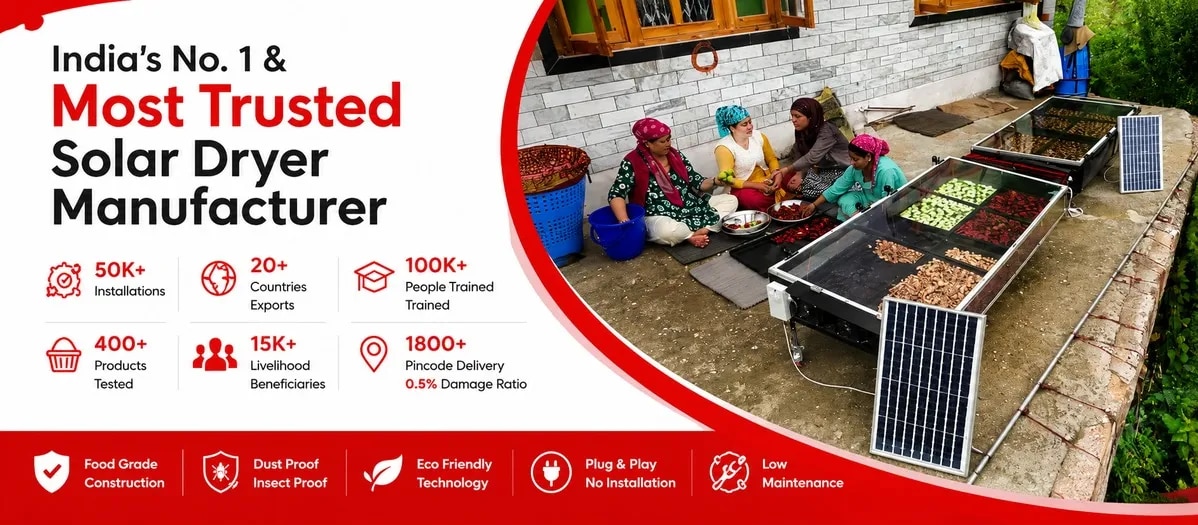
Farmers and farmer producer organisations may consider solar drying when they want to add processing capabilities to agricultural operations. Instead of selling every product only in its fresh form, suitable crops can potentially be processed into dried ingredients or other value-added products.Rudra Solar Energy states that its agricultural products dryer can be configured for farmers, FPOs, SHGs, cooperatives, and commercial processors, with capacity configurations from 5 kg per batch to 500 kg per batch.
Planning Capacity Carefully
Capacity should be selected based on actual processing needs rather than simply choosing the largest machine available. Important considerations include fresh quantity per batch, number of batches, crop season, drying characteristics, available installation space, and expected future expansion.A smaller system can be appropriate for trials or limited production, while a larger configuration may be considered for regular commercial processing.
Enclosed Drying and Product Handling
The enclosed design of a solar dryer can improve the physical separation between the product and the outdoor environment. Food-contact trays also provide an organised surface for loading material.Rudra Solar Energy's cabinet system uses tray-based loading and describes food-grade construction options, direct and indirect Know More solar heating, and optional electric or biomass backup depending on configuration.
Hygiene Still Depends on the Complete Process
An enclosed dryer does not automatically guarantee product quality. Raw-material quality, cleaning, preparation, tray sanitation, loading practices, drying conditions, cooling, packaging, and storage all influence the final product.Businesses should therefore consider the dryer as one part of the overall processing workflow.
Selecting a Solar Dryer
The right solar drying machine depends on the material and production requirement. A business should identify what it wants to dry, how much fresh material is available, the desired final condition, and how frequently the dryer will operate.Questions to consider include:
- What product will be dried?
- What is the fresh batch quantity?
- What is the initial moisture condition?
- What final moisture condition is required?
- How many batches are expected?
- Is electricity available at the site?
- Is backup heating required?
- How much installation space is available?
Rudra Solar Energy's location guidance similarly recommends evaluating the product, quantity, moisture, processing season, installation area, electricity availability, and future expansion plans before selecting a configuration.
Conclusion
Solar drying offers a practical way to use solar thermal energy for suitable agricultural and food-processing applications. Compared with open-sun drying, an enclosed solar dryer can provide a more organised environment while Solar Dryer helping reduce direct exposure to outdoor contaminants and changing weather.Rudra Solar Energy offers a range of solar drying systems covering small batch applications through larger commercial configurations. Businesses should evaluate the exact product, moisture requirements, capacity, airflow needs, site conditions, and processing schedule before selecting a machine.
A solar dryer is most effective when it is integrated into a complete processing system that includes proper preparation, drying control, cooling, packaging, and storage. With appropriate planning, Solar Dryer Supplier solar drying can become a useful technology for agricultural value addition and food processing.
 Report this wiki page